Listening through these first two sections was quite neat and engaging; seeing a glimpse of the past like these records provide and seeing the development of music over time is really cool.
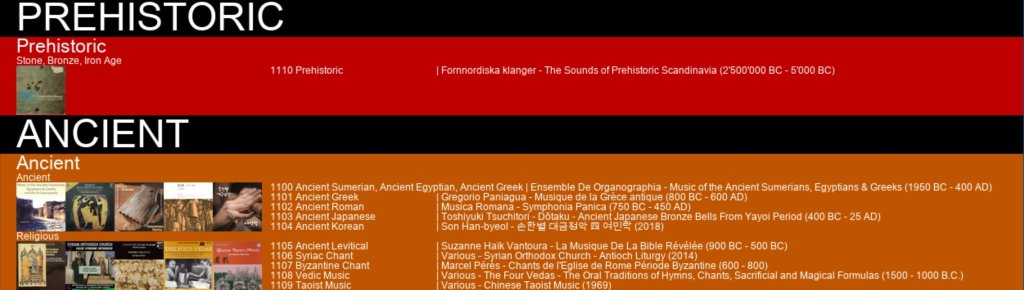
The lone Prehistoric entry, Fornnordiska klanger (rough translation: Old Norse Sounds?) is as advertised on the tin; demonstrations of instruments ranging back to 2,500,000 B.C. (Stone Age) to the Iron Age of Scandinavia; this is a early highlight for me, as I really enjoy the variety of textures and noises this record has, with field recordings present every once a while adding some really nice atmosphere to it. Sure, not really anything in the realm of “songs” but nonetheless enjoyable.
Moving through to the Ancient section, Music of the Ancient Sumerians, Egyptians & Greeks combines various musical hymns, pieces, fragments and excerpts performed by the Ensemble de Organographia; some intriguing pieces here, with some equally intriguing sounds/instrumentation. It is even moreso on Musique de la Grèce antique (Gregorio Paniagua) and Symphonia Panica (Musica Romana), another favorite so far, with Musica Romana utilizing two pan flutes found and reconstructed alongside harps, lutes, and reed instruments with original and replicated music, creating a very nice and cohesive record [1].
Dōtaku – Ancient Japanese Bronze Bells From Yayoi Period (400 BC – 25 AD) (Toshiyuki Tsuchitori) is unexpectedly my favorite here in this section; something about the recording, the resonance/the certain sound of the bells, the variety of rhythms and the general atmosphere of the record is really nice; almost meditative at times and attention grabbing the next. I would revisit this first if I had to say, not to diminish anything else here; I quite enjoyed listening to it.
Closing out the first half of the Ancient section is 손한별 대금정악 四 여민락 (Son Han-byeol) which was recorded in 2018 in the style of Korean Hyang-ak (translating to, I believe, indigenous/native or folk music), only with (I believe) a version of a flute called a daegeum (per light research on the topic). I’m uncertain of the actual instrument being used, but regardless it’s quite calming, a 90 minute continuous album that, if this was recorded all at once, it is impressive for the endurance the player exhibits.
The second half of the chart is primarily religious pieces. The first is La Musique De La Bible Révélée (Suzanne Haïk Vantoura), has some of the best variety, with choirs some beautiful and subtle and some bombastic and powerful. Following this, Syrian Orthodox Church – Antioch Liturgy shows off chants and choir vocals as well, with different types of vocals that feel like they have a call and response style on certain tracks, where one leads and the choir comes in to answer. Chants de l’Eglise de Rome Période Byzantine (Marcel Pérès) furthers the beautiful choir chanting; it does seem kind of samey throughout this particular record but its sound never gets old, nor do I want to turn it off; the tracks and their similar nature are just noticeable to me.
The final two in this section are representatives of Vedic music and Taoist music. The former selection was The Four Vedas – The Oral Traditions of Hymns, Chants, Sacrificial and Magical Formulas; this particular collection was quite lengthy and dealt with a lot of chants as this half seems to do, and while I don’t really comprehend much being said here I do admire the impressive recitation and repetition of these chants; when multiple vocalists are chanting together it draws you into it.
The final record of this section, Chinese Taoist Music, is my favorite of this half. The variety of instrumentation as well as the vocal chants are all so interesting, with varied themes (per the titles), such as boats being prepared and launched, funeral marches, purifying minds and water. It’s a bit odd as, as far as I know, these are not intended purely for musical enjoyment but are also for their intended actions such as inspiring religious followers and achieving inner harmony (per my brief research in how music relates to Taoism), but simultaneously they are enjoyable in an audio sense and historically as well. Tao is a subject I’d be interested in learning more about.
It’s hard to say anything critically about these early albums as their intent was not just for music’s sake but for many reasons, some being religious reasons, for traditional reasons, etc. But they are all fascinating in their own way. A great start on this road.
[1] Discogs source
 Beautiful Extremes, Etc. - b4bbl3.com